


Thank you for Subscribing to Electrical Business Review Weekly Brief


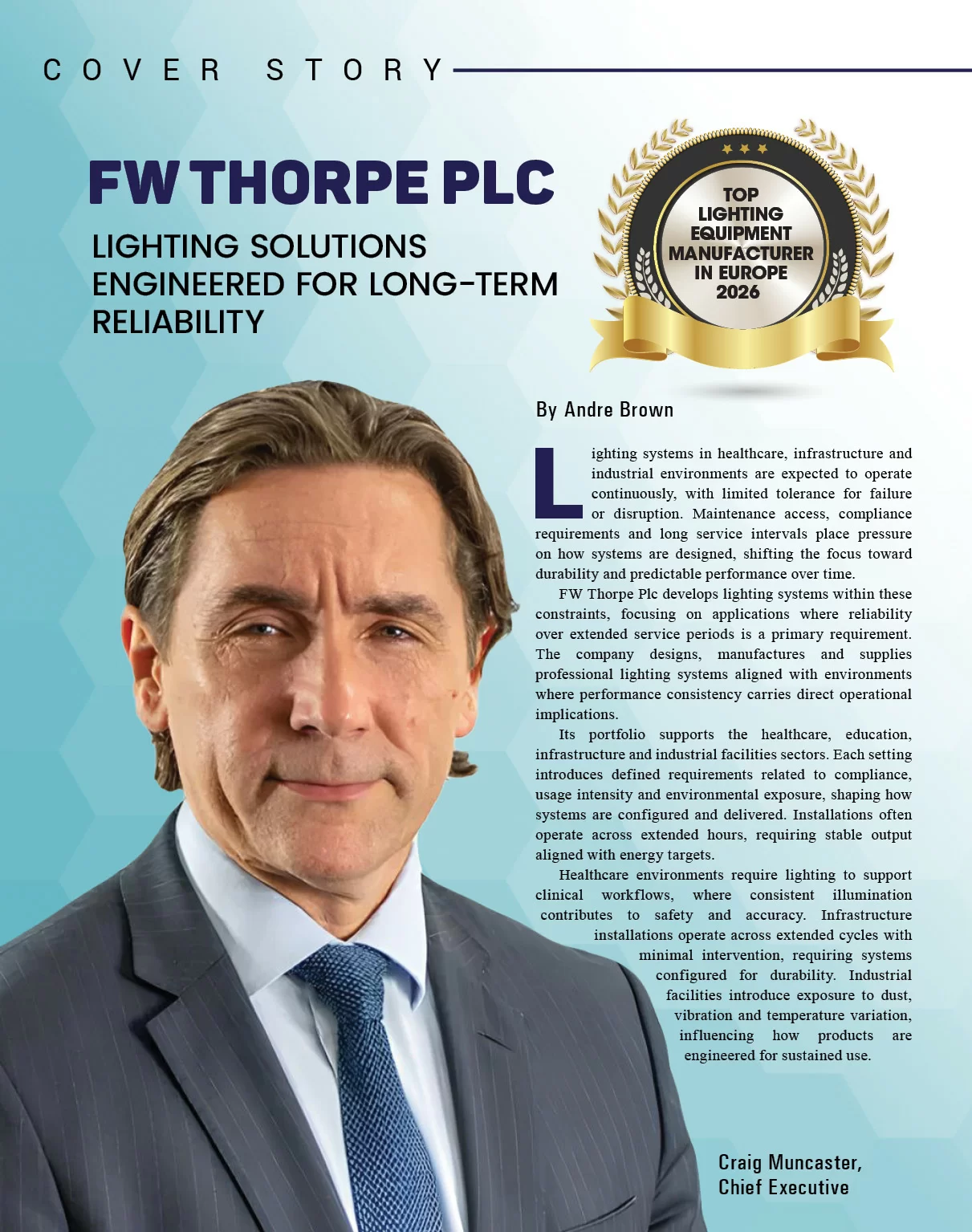
 Craig Muncaster, Chief Executive
FW Thorpe Plc develops lighting systems within these constraints, focusing on applications where reliability over extended service periods is a primary requirement. The company designs, manufactures and supplies professional lighting systems aligned with environments where performance consistency carries direct operational implications.
Its portfolio supports the healthcare, education, infrastructure and industrial facilities sectors. Each setting introduces defined requirements related to compliance, usage intensity and environmental exposure, shaping how systems are configured and delivered. Installations often operate across extended hours, requiring stable output aligned with energy targets.
Healthcare environments require lighting to support clinical workflows, where consistent illumination contributes to safety and accuracy. Infrastructure installations operate across extended cycles with minimal intervention, requiring systems configured for durability. Industrial facilities introduce exposure to dust, vibration and temperature variation, influencing how products are engineered for sustained use.
Structuring Systems around Lifecycle Requirements
Product development is aligned with lifecycle expectations rather than initial installation cost. Systems are configured to maintain consistent output across extended periods, reducing the need for frequent intervention. Design parameters reflect usage conditions, environmental exposure and long-term energy consumption.
Lighting systems are developed as integrated configurations, combining luminaires with control frameworks and application-specific requirements. Wireless control platforms enable luminaires to communicate occupancy data and adjust output levels based on real-time conditions, allowing installations to respond dynamically while maintaining required illumination.
Control integration enables defined operational states. Lighting output reduces during low occupancy periods and returns instantly when activity is detected. Daylight contribution is factored into adjustments, allowing systems to maintain consistent illumination while limiting unnecessary energy use.
 System architecture supports performance across varied environments. Healthcare installations maintain stable output for continuous use while supporting task-specific adjustments. Industrial environments require systems capable of maintaining performance under variable load conditions without output fluctuation.
Serviceability is incorporated into system design. Components are arranged to allow maintenance access without affecting surrounding installations, particularly in environments where interruptions carry operational impact. Modular configurations allow replacement of individual elements without full system shutdown.
Thermal management and component selection are aligned with extended use. Heat dissipation is addressed through structural design and internal configuration, supporting stable operation over time. Electrical components are selected to reduce failure risk and maintain consistent output across long service intervals.
Group Structure and Manufacturing Control
FW Thorpe Plc operates through a group of independently managed businesses, each focused on defined product categories or regional markets. Thorlux Lighting, Zemper, Famostar and SchahlLED contribute expertise across emergency lighting, industrial systems and specialist applications.
Each business maintains technical focus within its domain. Emergency lighting systems incorporate automated self-testing functions, allowing luminaires to perform scheduled checks and report system status. Compliance monitoring supports adherence to safety requirements without reliance on manual inspection processes.
 Industrial lighting solutions are configured for durability under demanding conditions, including exposure to dust, vibration and temperature variation. Specialist applications are developed in alignment with environment-specific requirements, ensuring systems perform according to the installation context.
Collaboration across the group supports development consistency. Engineering knowledge is shared across business units, allowing improvements in system design, thermal performance and component durability to extend across product ranges. Procurement processes are coordinated to maintain material quality and production efficiency.
Manufacturing remains central to the company’s operating model. Production facilities in the UK and Europe allow direct control over quality, process stability and output consistency, supporting alignment between design intent and manufactured products. Close integration between engineering and production enables rapid implementation of technical adjustments.
Process control measures are applied across production cycles. Calibration, testing procedures and inspection protocols ensure products meet defined specifications before deployment. Validation under simulated operating conditions allows systems to be assessed against expected performance requirements.
Standards applied within manufacturing support these processes. Certifications, including ISO 9001 and ISO 14001, provide structured frameworks for quality management and environmental performance. These frameworks support documentation, traceability and continuous improvement across production operations.
Sustainability Integrated Across Market Presence
Environmental considerations are incorporated into system design through energy efficiency, material selection and lifecycle planning. Lighting systems are developed to reduce energy consumption while maintaining consistent performance, supporting alignment with building efficiency requirements.
Control systems contribute directly to energy management. Occupancy sensing, daylight adjustment and automated scheduling reduce unnecessary energy use while maintaining required illumination levels. Data generated through control platforms enables assessment of usage patterns and supports further optimisation.
Extended product lifespans contribute to reduced environmental impact. Systems designed for long-term use reduce replacement frequency, lowering material consumption and waste generation. These considerations are integrated into design decisions to align performance with environmental objectives.
Manufacturing practices reflect similar priorities. Energy management measures are implemented across production processes, alongside initiatives to reduce material waste and improve resource efficiency. Renewable energy integration within facilities contributes to lowering the environmental impact associated with manufacturing.
The company’s geographic presence extends across the UK, Europe, the Middle East and Australia. Regional operations align with local regulatory requirements and market conditions, supporting deployment across varied applications. Compliance with regional standards is incorporated into product development to ensure certification across different markets.
Expansion activities focus on strengthening technical capability. The acquisition of SchahlLED supports development in industrial lighting applications, particularly in environments requiring intelligent LED systems and integrated control functionality. This addition extends the capability in applications involving automation and monitoring.
Financial performance reflects a focus on stability and continuity. Revenue levels and consistent profitability support ongoing investment in product development and manufacturing capability. Long-term customer relationships contribute to repeat demand across sectors requiring reliable lighting systems.
As lighting systems continue to intersect more closely with energy management and infrastructure planning, FW Thorpe Plc responds through controlled design, manufacturing and system integration, supporting deployment across environments where reliability remains a primary requirement.
