


Thank you for Subscribing to Electrical Business Review Weekly Brief

Cobalt Energy
Alan McBirnie, Principal Electrical Engineer
Battery Energy Storage Systems: Balancing Renewable Energy and Grid Demand

Alan McBirnie
Most of us now agree that climate change is something important to consider. Most governments of the world have made pledges to work towards reducing greenhouse gas emissions to at least net zero. The UK Government is committed to reaching net zero by 2050.
Key components in achieving this objective are to reduce the use of fossil fuels and move towards renewable and low carbon energy sources such as wind, solar and nuclear and to electrify sectors like road transport and building heating. I was interested to find out how much of our current energy is sourced from fossil fuels and was surprised to find that 75.1 percent of our overall energy usage in the UK in 2024 was from fossil fuels as can be seen in the following figure 1: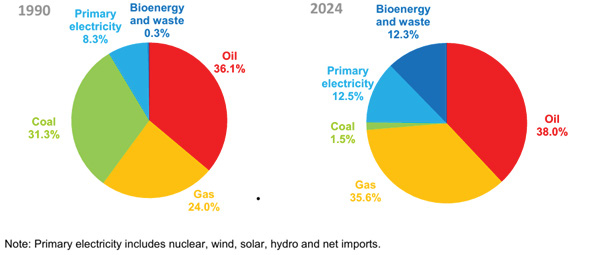 Figure 1. Inland Energy consumption, 1990 and 2024.
I was surprised at how large this figure is and was also shocked to find that such a small amount of our energy comes from renewables. This means that we’ll need a lot more sustainable energy if we are to be able to meet the targets.
Sustainable energies rely heavily on electricity as a means of distribution. The government policy states “The net zero economy will be underpinned by cheap clean electricity, made in Britain. A clean, reliable power system is the foundation of a productive net zero economy as we electrify other sectors – so we will fully decarbonise our power system by 2035, subject to security of supply. Our power system will consist of abundant, cheap British renewables, cutting edge new nuclear power stations, and be underpinned by flexibility including storage, gas with CCS, hydrogen and ensure reliable power is always there at the flick of a switch.”
The National Energy System Operator (NESO) has published data showing the amount of each fuel type used for electricity generation as can be seen in the following figure 2:
Figure 2. Clean sources are already reducing the share of fossil fuel generation. Source: NESO Clean Power 2030 Data Workbook_V003 (3)
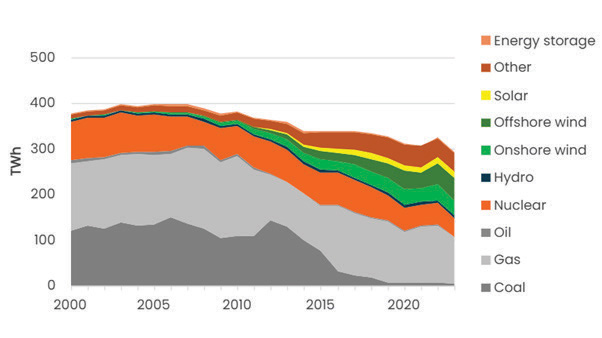 32 per cent of the electricity generated in 2025 was from fossil fuels (source: Energy Trends produced by Department for Energy Security & Net Zero Energy Trends: UK electricity - GOV.UK).
One thing that wind and solar energy generation have in common is that the production rate is not constant, since of course the wind doesn’t always blow and the sun doesn’t always shine and we can’t do much about that! This is one reason why there needs to be a way to balance supply and demand and that’s where Battery Energy Storage plays a significant role.
The UK’s Battery Energy Storage System (BESS) capacity has grown rapidly, from 0.5 GWh total annual electricity output from batteries in 2017, to almost 2,300 GWh in 2025. This is driven by a combination of technology advancements, installation capability, and policy changes.
Figure 3 below shows this sharp increase in Battery utilisation, primarily from 2021 onwards. This coincided with the launch of the UK government’s Net Zero Strategy, committing to clean electricity by 2035 and explicitly driving reliance on flexible energy storage, which fast-tracked large-scale BESS.
Figure 3. Monthly Great Britain (GB) grid-scale battery input and output (GWh), 2017 to March 2026.
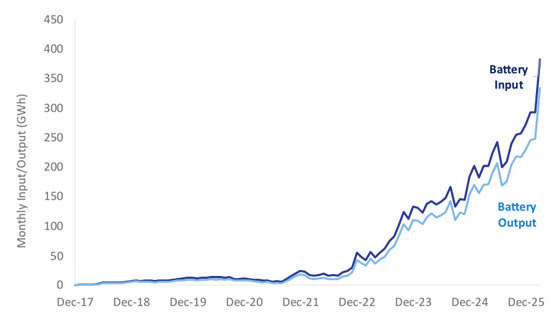 Analysis by NESO, published in Clean Power 2030 Annex 1: Electricity demand and supply analysis suggests that by 2030 Great Britain will need 23-27 GW installed capacity of BESS.
In conclusion, there is a significant amount of data supporting a change to the way we use energy together with government commitment. As we move away from fossil fuels our use of electricity will increase massively. Electricity generation is already moving towards sustainable sources, but the demand is also set to rise. As the demand for electricity rises together with the fact that renewable methods of generation are affected by weather and seasonal variations, the need for storage is rising sharply.
Cobalt Energy has been involved at the forefront of this transition since 2018, supporting BESS projects in various capacities, including EPC contractor, Technical Advisor, Owner’s Engineer, Principal Designer and Project Manager.
Delivering complex BESS infrastructure takes expertise, precision and collaboration - and Cobalt Energy’s latest project at Sizing John phase 2, is a great example of that in action. During the first phase, Cobalt provided technical due diligence, carried out civil and electrical design reviews, supported the grid connection process, and fulfilled the Principal Designer role under CDM regulations. In the second phase we are leading the delivery of the Civils and Electrical Balance of Plant (BoP), including the installation of major equipment as EPC contractor.
Cobalt’s experience in BESS includes:
• The Carnegie Road BESS facility is a 20MW/0.5hr LithiumIon System for Fast Frequency Response Electrical Storage System, built on a small site (0.4 hectares) at Carnegie Road in Liverpool. Cobalt Energy had a central role in delivering this facility leading the construction management, commissioning management and acting as the Authorising Engineer. Construction began in Aug’18 and the facility was ready to energise in Nov’18.
• Native River BESS is a 57MW/2hr facility located in the northwest of England. Cobalt Energy acted as Client Engineer and Principal Designer to ensure an effective technical delivery of the project. The site is now operational and was energised in Aug’24.
• Sambar Power BESS in Cornwall is 47MW/2hr, with the ability to augment to 4hr. Starting in 2024, Cobalt played a central role across all phases of the project lifecycle, from early design and planning through to construction oversight and technical assurance as the Client’s Project Manager, Owner’s Engineer, Principal Designer, and Technical Advisor. This project is ongoing and awaiting a grid connection date.
• Old Allen Road BESS is a 100MW/2hr, with space to augment to 4hr. Cobalt Energy’s role is Project Assurance, Technical Advisor and Grid Code Manager. Energisation is expected in 2028.
With the rise in scale of BESS projects, the connection directly to Transmission is increasingly more important, which is where Cobalt has extensive experience.
As the industry continues to evolve, challenges such as increasing grid connection waiting times are emerging. Cobalt remains at the forefront by keeping pace with changing policies, industry developments and technological advancements.
The articles from these contributors are based on their personal expertise and viewpoints, and do not necessarily reflect the opinions of their employers or affiliated organizations.
