


Thank you for Subscribing to Electrical Business Review Weekly Brief


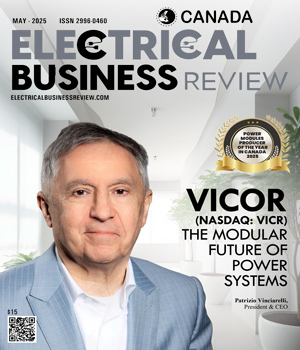
 Patrizio Vinciarelli, President & CEO
At the core of its innovation are power modules transforming how we think about power delivery, offering an alternative to traditional solutions. These modules pack unprecedented power density into incredibly compact and lightweight designs—up to five times denser than conventional systems and weighing as little as 674mg—an essential factor for industries where space and weight are at a premium. While conventional setups scatter heat unpredictably, Vicor ensures uniform and predictable heat dissipation. This means simplified thermal management that enhances the overall reliability of the systems, making integration smoother and more predictable.
Vicor’s exceptional plug-and-play solutions eliminate the need for expensive system overhauls and minimize downtime, making it a go-to choice for manufacturers where every second and every watt matters. Designed to support industries like industrial automation, high-performance computing, robotics, transportation, and manufacturing, it delivers easy-to-deploy solutions for power delivery networks that provide the highest density and efficiency from source to the point of load.
“We have always believed that highly automated U.S. manufacturing with vertical integration, close collaboration between product development, manufacturing processes, and operations is key to synergistic value opportunities leveraging best-in-class products,” says Patrizio Vinciarelli, president and chief executive officer.
While conventional setups scatter heat unpredictably, Vicor ensures uniform and predictable heat dissipation. This means simplified thermal management that enhances the overall reliability of the systems, making integration smoother and more predictable.
But speed is just the beginning. Vicor’s solutions are engineered for unmatched flexibility to make sure systems remain scalable and future-proof. Whether replacing or adding modules as needed, they eliminate the headaches of complex discrete systems and rigid ‘silver box’ power systems, making it easy for the clients to build an effective power delivery network (PDN). No more guesswork—just rapid, precise design at the fingertips. For clients designing PDN from scratch, the ‘whiteboard tool’ provides an intuitive online workspace to architect and analyze their power systems in minutes, allowing clients to generate a complete PDN in minutes, providing a complete, optimized PDN tailored for maximum efficiency, cost-effectiveness and performance.
Backed by over 30 years of engineering expertise, Vicor Power Systems is the first choice for those who need efficient solutions but lack the time or specialized knowledge to build them from scratch.
From 12V to 48V: The Leap toward Efficiency
12V power systems have long been a standard in many industries, providing a foundation for powering devices and systems using cables, connectors and PDNs, designed to operate efficiently at this voltage level. But as modern technologies push the boundaries of performance and functionality, the challenge lies in their inefficiency at higher power levels. As power demands grow, 12V systems begin to show their limitations. At higher power levels, their inefficiency becomes glaring—requiring thicker cables and bulkier connectors—causing significant power losses. This not only adds complexity to system design but hinders scalability, creating roadblocks for innovation.
Enter Vicor’s 48V system, a transformative solution designed to surpass the limitations of its 12V predecessor. By operating at a higher voltage, 48V systems drastically reduce the current required to deliver the same amount of power while maintaining safety at extra low voltage (SELV) levels. Unlike traditional methods that regulate power down to 12V before delivering it to the load, the new-gen systems bypass this intermediate step, converting directly to the load voltage. This shift substantially decreases power losses (I²R losses) and allows for lighter, more compact cabling and connectors.
But there lies a challenge. To upgrade older systems to 48V, redesigning 12V legacy systems becomes a cumbersome task. To tackle this adversity, Vicor has introduced DCM3717, a new highly efficient product—up to 96.5 percent—bridging 48V to 12V and vice versa. Its compact design is six times smaller than a conventional 1/4 brick converter, enabling seamless integration onto existing 12V boards. The result? Clients can achieve next-generation performance without the hassle and expense of a full system overhaul, setting a new power density benchmark.
Parallel operation also makes it possible to attain higher power levels above the 750W capability of one module
Precision Meets Performance
DCM3717 and other product lines, such as zero-voltage switching (ZVS), current multiplier (VTM), and bus converter modules (BCM), extend Vicor’s capability to deliver cuttingedge power solutions. As industries push for even greater performance, advanced systems are purpose-built to tackle the rising complexity of image-processing applications. One manufacturer faced a challenge when upgrading the image processing capabilities of their machine vision systems. While the need for computing power was clear, the equipment’s fixed form factor left no room for larger power supplies or additional components. Future scalability also had to be considered, as subsequent upgrades would demand even more power.
The manufacturer turned to Vicor for a game-changing solution—and the results were nothing short of transformative. Vicor’s ZVS buck regulators, with a remarkably small footprint of just 10 x 14mm, swiftly integrated into their system without demanding extra space. Despite their small size, these regulators delivered an impressive 95.5 percent efficiency, slashing heat waste and eliminating the need for complex thermal management systems. The impact was transformative. With Vicor’s solution, the manufacturer upgraded their system to handle powerful image processing faster and ensured that the design remained scalable for future enhancements.
The upgrade was a breakthrough. Vicor eliminated the inefficiencies and allowed the company to achieve greater throughput and precision in their automated production line while maintaining their equipment’s fixed dimensions.
Great Ideas Power Great Solutions
Diversity isn’t just a value at Vicor—it’s a driver of transformation. It fosters an inclusive environment where creativity thrives and innovation flourishes by embracing the perspectives and backgrounds of its global workforce. The belief that great ideas can come from anyone is more than just a principle—it’s the foundation of Vicor’s success. Whether designing advanced power systems for data centers or enhancing efficiency for manufacturing plants, Vicor’s inclusive culture sparks innovation and collaboration at every level.
This collaboration between creativity and expertise drives the development of its modular power systems across diverse industries. In underwater exploration, high-density modules have revolutionized remotely operated vehicles (ROV) by enabling lighter and safer tether cables, extending mission capabilities. Similarly, in hybrid vehicles, Vicor eliminates the need for intermediate batteries by converting high-voltage power to 48V or 12V, paving the way for more efficient and streamlined systems. Even unmanned aircraft are taking flight to new heights with compact and efficient solutions that free up critical space for advanced communications while extending operational range, pushing the boundaries of what’s possible in aerial technology.
From powering the most advanced technologies to enabling solutions that tackle real-world challenges, Vicor’s modular innovations are more than components—they’re catalysts for progress. Every new system empowers engineers, innovators and visionaries to dream bigger, design smarter and deliver faster. Great ideas may power great solutions, but with Vicor, they also power a brighter, smarter and more connected world.
Power Delivery Architectures for High-Density Systems
Power delivery has moved from a supporting function to a defining constraint in modern electronic systems. As computing intensity rises across data centers, industrial automation and robotics, legacy approaches built around low-voltage distribution and discrete components begin to show structural limitations. Higher power demand forces increased current, which in turn drives losses, bulkier cabling and complex thermal management. These inefficiencies do not remain isolated within the power subsystem; they cascade into system size, reliability and scalability, ultimately shaping how far a product can evolve.
A more effective approach begins with how power is distributed. Systems designed around higher voltage distribution reduce current requirements for the same power level, directly lowering resistive losses and easing constraints on connectors and interconnects. This shift simplifies the physical layer while creating room for denser and more compact system designs. It also allows engineers to think beyond incremental upgrades and instead reconfigure power delivery in a way that aligns with growing performance expectations.
Design velocity has become equally important. Traditional power architectures often demand extensive validation cycles, where each component interaction must be tested and requalified. This slows product development and ties engineering resources to troubleshooting rather than innovation. Pre-engineered building blocks that arrive validated and ready for integration can significantly compress these timelines. When combined with design tools that allow rapid configuration and analysis of power networks, they enable teams to move from concept to deployment with greater confidence and fewer iterations.
Thermal behavior remains another critical factor. In conventional setups, heat is often distributed unevenly, creating localized hotspots that complicate cooling strategies and reduce long-term reliability. Predictable heat distribution, supported by compact module design, simplifies thermal planning and allows systems to operate within tighter physical constraints. This becomes especially relevant in applications where space is fixed but performance requirements continue to rise.
Flexibility in scaling also defines long-term viability. Systems rarely remain static; they evolve with new requirements, higher processing loads or expanded functionality. Architectures that support modular expansion allow incremental scaling without forcing a complete redesign. Compatibility with existing infrastructure further reduces transition barriers, particularly for organizations managing large installed bases. The ability to bridge older systems with newer architectures ensures that progress does not come at the cost of disruption.
These shifts point toward a model where power delivery is treated as an adaptable architecture rather than a fixed assembly of components. Buyers evaluating solutions in this space must therefore focus on how effectively a system reduces electrical losses, how quickly it can be designed and deployed and how easily it can scale or integrate with existing environments. Decisions anchored in these dimensions tend to produce systems that are not only efficient at launch but remain viable as demands increase.
Vicor aligns closely with this direction through its modular approach to power delivery. Its portfolio centers on compact power modules that support higher voltage distribution and direct conversion to load, reducing inefficiencies associated with intermediate steps. It enables faster development through pre-validated components and design tools that assist in building complete power networks. Its solutions also address integration challenges by allowing upgrades to existing systems without requiring full redesign. This combination positions it as a strong choice for organizations prioritizing efficiency, speed of development and scalable power architectures.
...Read more
